



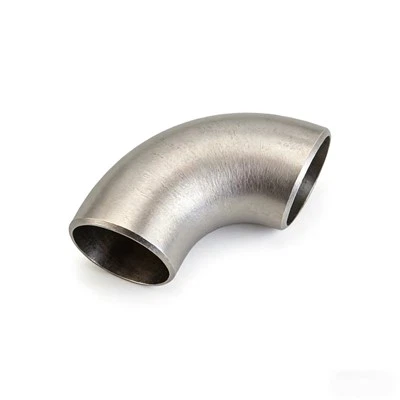
Stainless Steel 45 Degree Elbow
We produce around 100,000 sets per year with a lead time near 20 days. Custom sizes are available and FOB pricing runs from US $1.8 per piece.
Stainless Steel 45 Degree Elbow
A shallow turn for tight manifolds and skids
This 45 degree stainless elbow routes drinking water lines, food and beverage plant runs and general process piping where a clean, compact change of direction is needed. The shallow 45 degree bend turns the line gradually, so flow loses less energy than it would around a sharper corner and the pressure drop across the component stays modest in continuous service. The fitting slots into tight valve manifolds, pump skids and beverage plant pipe racks, which is where most of these elbows end up on the spares list. Crews order spares for a specific line, and the end type has to match how that line is joined; otherwise an adapter or a re-threaded piece delays the job. On the rack, that shallow angle matters more than it sounds: crowded routes leave little room for a long radius, and the compact bend keeps the run clear of adjacent ductwork and cable trays.
The crew at the skid usually checks the end form first. Nobody wants to convert a welded body to threads on site.
What the stainless grades hold up against
The body is stainless steel supplied in SS304, SS316 or SS316L depending on the line specification. The chromium-nickel grades stand up to wet service, mild chemical exposure and atmospheric oxidation, and they weld and machine cleanly when the end form has to be prepared on site. The surface leaves the plant plain; paint, wrapping or coating follows the project's own corrosion practice once the piece enters the run. Grade choice tracks the fluid and ambient conditions rather than the price bracket, because a grade picked too low shows staining or pitting long before the fitting reaches the end of its service life.
Before the piece leaves the plant, surface condition and dimensions are checked against the listing record, and any burr, casting flash or uneven thread is dressed back to the body profile. Wall thickness and outside diameter are sampled against the listed size range, and the end faces are protected with thread or end caps until the joint is ready to close. On site, crews brush grit from the bore and the sealing face before assembly, because sand or scale left on a thread or gasket seat is the usual reason a fresh connection weeps after the first pressure test. Spare pieces ride along with the next valve or fitting order, held in the maintenance store by line size and end type so the replacement matches the run it serves.

Size, rating and listed service
The listing leaves a fixed size range open; dimensions are agreed against the project drawing rather than assigned in the source record. No fixed pressure class is assigned on the source listing, so line rating should be confirmed against the piping specification before installation. The certification record on the listing is left open; no standard or certificate number is assigned in the source record. Listed service on the source record: Water Supply.
Dimension selection starts from the flow requirement on the line drawing, then narrows against pressure class, span length and the end form listed for that fitting. Where two sizes sit close on the range, the larger wall and diameter give margin against transient surge and support loads, while the smaller size keeps weight and cost down on branches that carry little flow. The drawing should fix outside diameter, wall thickness and end preparation before the order is cut, so the workshop does not guess at a dimension that falls outside the listed stock range. Spare sets are held in the maintenance store tagged by line size, end form and pressure class, which keeps the replacement matched to the run it serves. On installation, supports and hangers follow the span conditions listed for that pipe. The joint is aligned square before bolts come tight or welds are laid down.
Matching the end form to how the line is joined
Three end families appear on the listing: butt weld, threaded and socket weld. Butt weld ends prepare straight bevels that fuse to matching pipe in a rigid, leak-tight joint suited to larger process and steam runs. Threaded ends accept standard pipe on smaller lines and let maintenance crews remove a section without cutting. Socket weld ends slide the pipe into a recessed bore before fillet welding, a common choice for compact branch and instrument connections. When the spares list splits by line type, the matching end version is packed for each run, so the crew does not convert one end form into another on site.
How the joint behaves under service depends on the end form chosen for that line. Welded ends fuse into a rigid connection that moves with the pipe, but they need a qualified weld procedure, joint fit-up and post-weld inspection as the quality plan requires. Threaded ends come apart with standard tools, which keeps maintenance simple on small-bore branches, while grooved and push-on seats rely on gasket compression to seal under pressure and allow a small angular deflection after laying. Each end family suits a different line, and the choice follows the spool list rather than a default picked at the warehouse counter.
| Part | Value |
|---|---|
| Listed size range | - |
| Listed standard | - |
| End connection | Butt Weld / Threaded / Socket Weld |
| Pressure rating | - |
| Intended service | Water Supply |
| Model reference | 45 Degree Stainless Steel Elbow |
| Product category | Elbow |
| Body material | Stainless Steel (SS304/SS316/SS316L) |
| Section shape | Elbow |
Ordering practice and packing notes
The listed minimum order sits at Min. Order: 10 Pieces, and the FOB bracket runs US $1.8–90 / Piece. Delivery follows the listed lead-time note: 20 days (1–200 Pieces); to be negotiated (>200 Pieces); larger lots are negotiated at order confirmation. Pieces carry the YH mark and ship from China, and custom dimensions are accepted where the line falls outside a standard stock range.
The listing leaves any open field to be confirmed against the project drawing; no certificate number or rating is assumed where the source record leaves it blank.
Handling spares on the maintenance shelf
On site, the piece is handled with a sling or soft cradle rather than dropped onto the rack, and the end protection stays on until the joint is ready to close. Support clips and hangers are spaced to the span conditions on the drawing, so the body does not sag under its own weight between anchors. Where the run crosses a trench, chamber or equipment tie-in, the fitting is aligned square before the joint is tightened or welded; a skewed seat leaves one side under-compressed and shows weeping once pressure comes on. Crews record the line size, end form and pressure class on the spares tag, so the next replacement pulled from the store matches the existing run.
Hot Tags: Stainless Steel 45 Degree Elbow, China Stainless Steel 45 Degree Elbow manufacturers, pipe system connectors, Seamless Stainless Steel Elbow, Seamless Stainless Steel Tee, stainless steel low leakage fittings, stainless steel mechanical fittings, stainless steel pipe plug
You Might Also Like


Send Inquiry