


Joint
Pipe Expansion Joints & Dismantling Joints Manufacturer
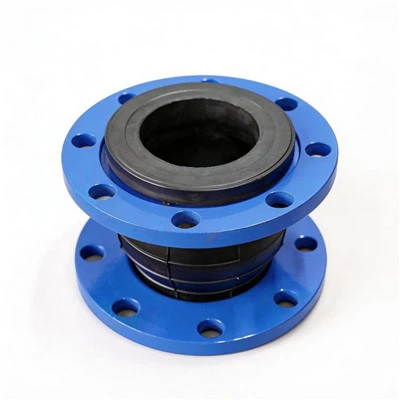
We manufacture flexible rubber expansion joints, double-flanged limit expansion joints, and metallic bellows compensators engineered for thermal expansion, pipeline misalignment, and pump vibration isolation. Production covers nominal sizes from DN15 to DN3200 (1/2" to 128") with pressure ratings up to PN25 / Class 300.


Product Range
|
Product Category |
Primary Components |
Size Range |
Movement Capability |
Standard Flange Drilling |
|
Single / Double Sphere Rubber Expansion Joint |
EPDM / NBR / FKM Body, Carbon Steel / Ductile Iron Flanges |
DN15 – DN3000 (1/2" – 120") |
Axial Compression: up to 25mm Axial Extension: up to 15mm Lateral Deflection: up to 22mm |
EN1092-2 PN10/16/25 ASME B16.5 Class 150/300 JIS 10K/16K |
|
Double Flange Limit Expansion Joint |
Ductile Iron GGG50 / Carbon Steel Body, NBR/EPDM Seal, Steel Tie Rods |
DN50 – DN2000 (2" – 80") |
Axial Displacement: ±50mm (Adjustable via limit studs) |
EN1092-2 PN10/16/25 BS4504 / DIN 2501 |
|
Dismantling Joint |
Retaining Ring, Sleeve, Gland, Tie Rods (Grade 8.8 / SS304) |
DN50 – DN2400 (2" – 96") |
Axial Adjustment: ±25mm to ±50mm for valve installation/removal |
EN1092-2 PN10/16/25 ASME B16.5 Class 150 |
|
Stainless Steel Bellows Expansion Joint |
SS304 / SS316L / SS321 Bellows, Weld End or Flanged Ends |
DN15 – DN1200 (1/2" – 48") |
Axial, Lateral, and Angular thermal expansion compensation |
ASME B16.5 Class 150/300 EN1092-1 |
Elastomer & Metallic Material Selection
Rubber Compounds
|
Material |
Suitable Media / Applications |
Operating Temperature |
|
EPDM (Ethylene Propylene Diene Monomer) |
Water, hot water, mild acids, alkaline media |
-20°C to +120°C |
|
NBR (Nitrile Rubber) |
Petroleum products, hydrocarbons, lubricating oil, compressed air |
-20°C to +80°C |
|
FKM (Fluoroelastomer / Viton) |
Concentrated chemical acids, high-temperature oils, corrosive fluids |
-20°C to +200°C |
|
Neoprene (CR) |
Seawater, sewage, weathering, ozone exposure |
-15°C to +90°C |
Flange & Retaining Ring Materials
|
Material Category |
Available Materials / Grades |
|
Ductile Iron |
GGG40 / GGG50 (EN-GJS-400-15 / EN-GJS-500-7) |
|
Carbon Steel |
Q235B / ASTM A105 |
|
Stainless Steel |
AISI 304 / 316 / 316L |
Mechanical Performance Standards
|
Parameter |
Specification |
Application / Notes |
|
Burst Pressure Margin |
Minimum design safety factor of 3:1 relative to maximum working pressure |
Example provided: PN16 joints are hydraulically burst-tested to ≥ 4.8 MPa |
|
Vacuum Rating |
Up to 750 mmHg vacuum |
Standard rubber expansion joints, as specified |
|
Internal Vacuum Rings |
SS304 / SS316 |
Used in suction-side pump lines to help prevent arch collapse |
|
Flange Parallelism |
Error within 1.0 mm |
Flange alignment requirement |
|
Bolt Hole Circle (PCD) Tolerance |
±0.5 mm |
CNC-machined flange drilling to match mating flanges |
Manufacturing operates under ISO 9001:2015 quality management procedures. Pressure testing and dimensional verification conform to ISO 5208 and EN 12266-1.
Raw Rubber Compound Testing (Rheometer & Tensile Test)
→ Molded Vulcanization (Hydraulic Pressing)
→ Flange CNC Machining & Surface Coating
→ Assembling Body, Flanges & Limit Control Rods
→ Hydrostatic Pressure & Vacuum Testing (100% Batch Sampling)
→ Dimensional Inspection & Marking
→ Final Packaging & Mill Test Report (EN 10204 3.1)
In-House Testing Capabilities
Rheometer & Rubber Compound Analysis: Verifies Mooney viscosity, vulcanization curve, tensile strength (≥ 15 MPa), and elongation at break (≥ 400%).
Hydrostatic Pressure Testing: Every batch undergoes shell pressure testing at 1.5 times the nominal working pressure (e.g., 2.4 MPa for PN16) held for a minimum of 10 minutes without pressure drop or deformation.
Cyclic Movement & Fatigue Test: Samples undergo 10,000 continuous compression-extension cycles to confirm rubber memory retention and structural integrity.
Coating Thickness Gauge: Epoxy powder coating thickness on ductile iron castings and steel bodies is measured to ensure a minimum of 250 µm (DFT) for underground burial protection.
Traceability: Heat numbers for metal castings and batch numbers for rubber compounds are permanently stamped on flanges and recorded in EN 10204 3.1 certificates.

Customization & Supply Options
Control Unit & Limit Rod Configurations
Optional limit rods, tie bars, or compression stops prevent excess pipeline elongation under unanchored pressure thrust.
01
Protective Linings & External Shields
PTFE/FEP internal sleeves for high-purity or ultra-corrosive media; external flame-resistant protective covers for high-temperature environments.
02
Surface Coating Options
Fusion Bonded Epoxy (FBE) coating (RAL 5005 / RAL 5015), Hot-Dip Galvanizing according to ASTM A153, and Polyurethane (PU) external coatings.
03
Custom Flange Drilling & Lay Lengths
Non-standard face-to-face dimensions, special PCD drilling patterns (e.g., AWWA C207, BS10 Table E, JIS 5K/10K/16K).
04
Packaging & Export Logistics
Heavy-duty ISPM 15 heat-treated wooden cases with internal steel strapping, flange face protective caps, and custom crate labeling.
05
Our Factory


FAQ

Request a Quote
Submit your project parameters to receive a technical proposal and quotation within 24 hours.
Email: anzhiyuan@yhmadeinprc.com.cn
Required Technical Details: Nominal pipe size (DN/NPS), working pressure (PN/Class), fluid medium, operating temperature, end connection standard, and limit rod requirements.